


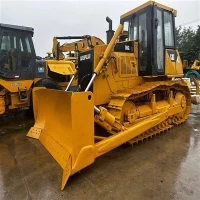
If you’re in the forestry game, you know the right equipment can make or break a job—especially when it comes to clearing land, building trails, or managing timber stands. For years, my team and I have supplied heavy-duty dozers, and the Caterpillar D6 Bulldozer is one of the most requested models for forestry work. But slapping a D6 into a forest job without thinking through the unique demands of wooded terrain is a quick way to run into headaches, from damaging sensitive soil to dragging in a dozer that’s too big (or too small) for the job. Here’s what I’ve learned after working with dozens of forestry operators who’ve bought used dozers from us—no stuffy manual stuff, just real, on-the-ground considerations.
First off, ground pressure is make-or-break in forestry. Unlike construction sites with compacted asphalt or gravel, forest floors are soft, often muddy, and covered in roots and duff. Too much pressure, and you’ll sink like a stone, get stuck for hours, or tear up the topsoil layer that trees need to regrow. That’s where track systems and blade configurations come in, and the D6 has options that work way better than smaller dozers like the Caterpillar D5 Bulldozer or even competitors like the KOMATSU D65 CrawlerDozers. Wait, let’s clarify: the D6’s LGP (Low Ground Pressure) tracks are non-negotiable for most forest work. LGP tracks spread the machine’s weight over a larger area, cutting ground pressure to under 8 psi, compared to the standard D6’s 12 psi. I’ve seen guys who skip LGP track get stuck so bad they had to call a second dozer to pull them out—wasting time and money. And don’t sleep on track shoes: rubber tracks are gentler on soil but wear fast on roots and rocks, while steel tracks hold up longer but can compact soil more. If you’re working in a mature stand where preserving the root zone matters, LGP rubber tracks are the move; if it’s a clearcut with lots of debris, steel tracks with grousers (the raised bits that grip the ground) are worth the extra maintenance.
Next up, blade size and type. The D6 typically comes with a U-blade (for pushing bulk material like logs or brush) or a S-blade (straight blade, better for grading trails). But here’s the thing: the blade can’t be so big that the dozer can’t maneuver around tight tree trunks or steep slopes. A U-blade on a D6 is great for clearing a 1-acre patch, but if you’re working along a narrow power line right-of-way that winds through trees, a S-blade might be more flexible. I’ve had forest operators come in thinking a bigger blade is always better, only to find the D6’s U-blade is too wide to fit between 12-inch oak trees, leading to missed spots or accidental tree damage. Compare that to smaller dozers like the Caterpillar D3 LGP Bulldozer, which has a narrower blade for tight spaces, but it’s underpowered for larger clearings. The D6 hits that sweet spot: powerful enough to move 2-3 tons of brush per pass, but maneuverable enough to work around standing trees if you set it up right.
Then there’s power and fuel efficiency. Forestry jobs often run long—we’re talking 10+ hour days, sometimes remote locations where refueling means a 45-minute drive. The D6’s 170-horsepower engine is perfect for most mid-sized forestry tasks, but you need to match it to the job. If you’re doing light trail building, a smaller, more fuel-efficient model like the KOMATSU D39 CrawlerDozers might save you money on fuel, but it’ll struggle with thick underbrush or wet soil that needs extra push. On the flip side, a D6 with a modified air filtration system is a game-changer for forest work—pine needles, dust, and wood chips can clog standard filters in a day, leading to engine damage. We always recommend adding a pre-cleaner kit when we sell a D6 to forestry clients; it costs a few hundred bucks but prevents a $5,000 engine repair down the line. Also, fuel type: the D6 runs on diesel, which is the only way to go for heavy forest work, but make sure the machine is set up for low-sulfur fuel—lots of remote areas only have that, and older D6s without the right modifications will have engine issues.
Terrain adaptation is another big one. Forestry sites aren’t flat construction zones—you’ve got slopes, uneven ground, and fallen logs. The D6’s hydrostatic transmission is way better here than a standard manual transmission (we always go for hydro when prepping D6s for forestry). Hydro lets you adjust speed and power smoothly without stalling when you hit a root or a small slope, which is crucial for keeping productivity up. I’ve seen operators with non-hydro dozers waste half their time restarting when they hit a bump, while D6s handle that stuff like it’s nothing. Also, slope rating: the D6 can handle up to 30-degree slopes, but you need to adjust how you operate it—never turn uphill, always keep tracks parallel to the slope to avoid tipping. We tell clients to practice on a gentle slope first before tackling steep terrain; the D6 is powerful, but it’s not designed for stunt work. One thing to watch for: tree stumps. A D6 can push over small stumps, but big ones (over 2 feet wide) will jam under the tracks or bend the blade’s push arms. If you’re working in an area with lots of big stumps, we recommend adding a stump shank attachment to the D6 before you start— it’s a cheap add-on that saves you from breaking a $1,000 blade part.
Maintenance and parts availability. Let’s be real: forest work is tough on equipment. Mud, water, wood debris—all that stuff eats at a dozer. When we sell a used D6, we always emphasize regular maintenance, but not just the basic oil changes. Track tension is huge in forestry: loose tracks can come off (I’ve seen that happen more times than I can count in soft soil), and tight tracks wear out fast. We check track tension every 50 hours for forestry use, not the standard 100. Also, air filter changes—we already mentioned that, but it’s worth repeating. And when parts break, you need to get them fast. That’s why we stock D6-specific track shoes, filters, and blade parts right here, so if you’re out on a job and a track breaks, you can pick up a replacement the next day instead of waiting a week. A lot of operators forget that when they go for a cheaper brand—KOMATSU D65 parts might be cheaper, but if you’re in a remote forest, shipping time will kill your productivity.
Wait, let’s circle back to size matching. A lot of guys think bigger is better, but the D6 isn’t the right fit for every forest job. If you’re doing small-scale residential land clearing (like ½ acre for a new driveway), a D6 is overkill—you’d be burning extra fuel and damaging more soil than needed. In that case, a smaller model like the Caterpillar D3 LGP Bulldozer would work just fine. But if you’re doing a 10-acre commercial clearing or building a 5-mile trail network, the D6’s size is perfect—powerful enough to move lots of material without being too big to maneuver. We always ask clients what kind of acreage they’re working on before we recommend a D6; if it’s under 5 acres, we’d point them toward the smaller models, but if it’s larger, the D6 is the sweet spot. That’s why we don’t just sell dozers—we help you pick the right one for the job, which is way more important than just grabbing the biggest machine.
One last thing: operator training. Even the best D6 will underperform if the operator doesn’t know how to use it in forestry. We run free 1-day training for all our used dozer buyers, teaching them how to work around trees, avoid soil compaction, and handle steep slopes. A lot of guys who buy their first D6 from us don’t realize that forestry dozer operation is different from construction—you can’t just push everything flat; you have to preserve existing trees where needed, and work with the terrain instead of against it. For example, if you’re clearing a trail, you don’t want to cut down every tree along the edge—you can use the D6’s U-blade to push brush back, leaving standing trees for shade and erosion control. That’s a small tip, but it makes a huge difference in the quality of your work.


At the end of the day, using a Caterpillar D6 Bulldozer in forestry is all about matching the machine’s features to the specific job. You can’t just take a generic construction dozer and drop it in the woods—you need to adjust tracks, blade, and maintenance to fit soft soil, tight spaces, and long hours. If you’re in the market for a reliable D6 (or even exploring smaller or competing models, like the Komatsu D65 CrawlerDozers) for your forestry work, we’re here to help. Whether you need to pick the right model, get a setup that works for your site, or find replacement parts fast, we’ve got you covered. Hit us up to chat through your needs and find the perfect dozer for your next forestry job.
References:
- Caterpillar Inc. "Caterpillar D6 Dozer Specifications for Forestry Applications." Caterpillar Global Forestry Division, 2023.
- Forest Equipment Owners Association. "Ground Pressure and Soil Preservation in Forestry Dozing." Journal of Forest Engineering, vol. 34, no. 2, 2022, pp. 45-52.
- Komatsu Ltd. "Comparative Performance Analysis of Komatsu D65 and Caterpillar D6 in Soft Terrain." International Journal of Heavy Equipment Management, vol. 10, no. 1, 2021, pp. 112-127.
- U.S. Department of Agriculture Forest Service. "Best Management Practices for Dozer Operations on Forested Lands." USDA Forest Service Technical Report, 2020.
- Used Construction Equipment Association. "Maintenance Guidelines for Used Dozers in Remote Forestry Locations." Equipment Maintenance Magazine, vol. 18, no. 4, 2023, pp. 78-83.